


New Zealand note: shown for information only, not an endorsement or ad. Under the Online Casino Gambling Act 2026 (in force 1 May 2026), advertising unlicensed online casino gambling is prohibited, and from 1 December 2026 operators that have not applied for a Department of Internal Affairs licence must stop offering online casino games to New Zealanders. R18. Gamble responsibly — Gambling Helpline Aotearoa 0800 654 655.
Spin Casino is a long-running online casino brand that New Zealanders often encounter when researching casino apps. This guide sets out the plain facts: what it is, who runs it, how it is licensed overseas, and — most importantly — how New Zealand’s rules changed in 2026.
It is written to inform, not to promote. Nothing here recommends signing up or depositing. Online casino play carries real financial risk, and the New Zealand legal position is now very different from how it looked even a year ago.
What Spin Casino Is
Spin Casino launched in 2001, originally under the name Spin Palace, and was later rebranded to Spin Casino.
It is operated by Bayton Ltd and sits within the Super Group family of casino brands, which also includes sister sites such as Ruby Fortune, Jackpot City and Royal Vegas. Because these brands share an operating model, Spin Casino’s layout and account structure resemble its stablemates.
Its games come mainly from Games Global (the studio formerly known as Microgaming), with live-dealer tables supplied by Evolution. The catalogue runs to several hundred titles across slots (pokies), table games and live dealer.
One point matters more than any feature: Spin Casino is an offshore operator. It has served New Zealanders from outside the country under overseas licences — and that is now central to the legal picture.
The New Zealand Rules Changed in 2026 (Why This Matters Most)
For years, New Zealand had no domestic licensing system for online casinos. Offshore sites reached players here without local oversight and without New Zealand consumer protections attached.
That has changed. The Online Casino Gambling Act 2026 came into force on 1 May 2026 and created, for the first time, a licensing system for online casino gambling in New Zealand.
The regulator is the Department of Internal Affairs (DIA). Only a limited number of operators — capped at 15 — can hold a licence, allocated through a multi-stage process.
The reform was designed to add consumer protection and tax accountability to a market that previously had neither.
Licensed operators must meet strict conditions: letting players set time and spending limits, offering self-exclusion tools, following advertising restrictions, and — notably — a ban on credit-card deposits.
There is also a hard deadline. Existing offshore providers could keep operating under transitional arrangements only until 1 December 2026. After that, an operator must hold a DIA licence to lawfully serve New Zealanders.
Because who is licensed can change, the reliable way to check any operator’s New Zealand standing is through the Department of Internal Affairs, not the operator’s own marketing. See our overviews of online casino licensing in New Zealand and the regulation and legal framework.
Licensing and Fair Play, Explained Simply

New Zealand note: shown for information only, not an endorsement or ad. Under the Online Casino Gambling Act 2026 (in force 1 May 2026), advertising unlicensed online casino gambling is prohibited, and from 1 December 2026 operators that have not applied for a Department of Internal Affairs licence must stop offering online casino games to New Zealanders. R18. Gamble responsibly — Gambling Helpline Aotearoa 0800 654 655.
Spin Casino operates under a Malta Gaming Authority (MGA) licence — MGA/B2C/145/2007, held by Bayton Ltd — and has been associated with the Kahnawake Gaming Commission. It has also carried independent games testing from eCOGRA.
These are genuine credentials, but they are overseas credentials. An MGA licence is a Maltese licence, not a New Zealand one, and it does not by itself authorise a site to serve New Zealanders under the 2026 Act.
| Term | Plain-English meaning |
|---|---|
| RNG (Random Number Generator) | Software that makes each game outcome random rather than fixed. |
| RTP (Return to Player) | The share of all money wagered a game is designed to pay back over the long run — a 96% RTP implies a roughly 4% built-in house margin. It is a long-term average, not a per-session promise. |
| KYC (Know Your Customer) | The identity checks a regulated operator runs before paying out, using ID and proof of address. |
| Wagering requirement | How many times a bonus must be bet before related winnings can be withdrawn. |
| Sister sites | Separate casino brands run by the same parent company, sharing software and systems. |
You can read a fuller explanation in our guide to RTP explained.
How Online Casino Apps and Downloads Work

New Zealand note: shown for information only, not an endorsement or ad. Under the Online Casino Gambling Act 2026 (in force 1 May 2026), advertising unlicensed online casino gambling is prohibited, and from 1 December 2026 operators that have not applied for a Department of Internal Affairs licence must stop offering online casino games to New Zealanders. R18. Gamble responsibly — Gambling Helpline Aotearoa 0800 654 655.
Spin Casino, like most brands, runs in a mobile browser using web technology that adapts to any screen, so no download is required. Some brands also offer an Android install file (an “APK”) directly from their own site, because real-money gambling apps are often not available in the official app stores.
A word of caution rather than a how-to: installing an app from outside an official store means switching off a device safety setting, which raises the risk of installing tampered or malicious software. The browser version avoids this entirely. Our guide to casino app security explains what to weigh up.
Understanding Bonuses and Wagering Requirements (General Guide)
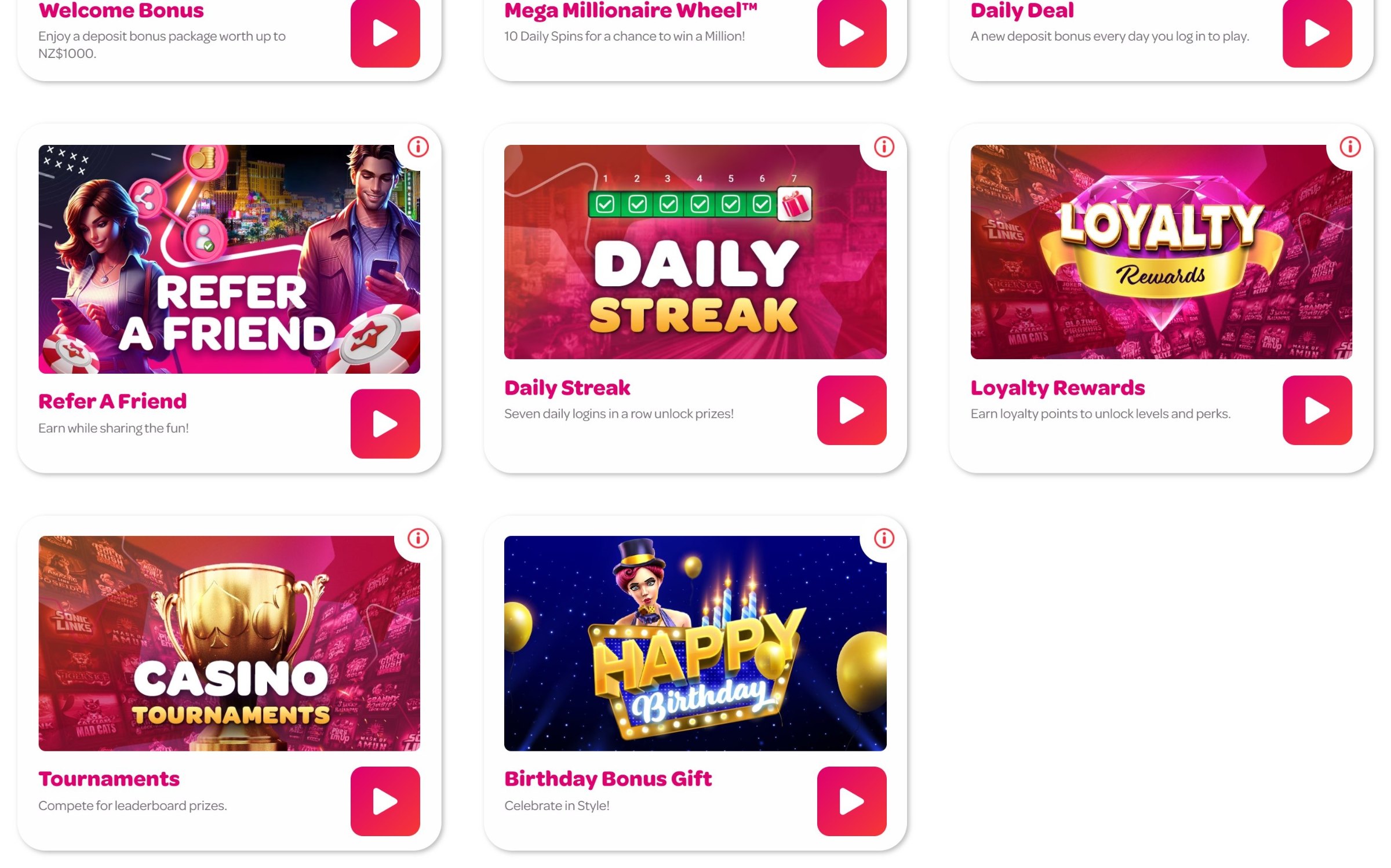
New Zealand note: shown for information only, not an endorsement or ad. Bonus figures are illustrative and subject to the operator’s terms. Under the Online Casino Gambling Act 2026 (in force 1 May 2026), advertising unlicensed online casino gambling is prohibited, and from 1 December 2026 operators that have not applied for a Department of Internal Affairs licence must stop offering online casino games to New Zealanders. R18. Gamble responsibly — Gambling Helpline Aotearoa 0800 654 655.
Casino promotions — welcome offers, deposit matches, low “$1 deposit” deals, free spins, or voucher codes — are the most misunderstood part of online gambling, so it is worth explaining the mechanics rather than any specific promotion.
The key concept is the wagering requirement (also called playthrough): the number of times you must bet a bonus before winnings from it become withdrawable.
Here is an illustrative example, not a live offer:
A $100 bonus with a 50× wagering requirement means placing $5,000 in bets before the associated winnings can be withdrawn.
A few points worth knowing: low-deposit “entry” offers are marketing devices, not free value, and they often carry higher wagering requirements than standard bonuses. Slots usually count 100% toward wagering; table games far less. Under the 2026 regime, bonuses and inducements are also restricted for licensed New Zealand operators.
The practical takeaway: read the terms before opting in. Our casino bonuses overview breaks down the categories.
Payments, Verification and Sister-Site Networks

New Zealand note: shown for information only, not an endorsement or ad. Availability of methods and currencies can change. Under the Online Casino Gambling Act 2026 (in force 1 May 2026), advertising unlicensed online casino gambling is prohibited, and from 1 December 2026 operators that have not applied for a Department of Internal Affairs licence must stop offering online casino games to New Zealanders. R18. Gamble responsibly — Gambling Helpline Aotearoa 0800 654 655.
Sites courting New Zealand players typically support accounts in New Zealand dollars (NZD) to avoid conversion costs, using local options like POLi, debit cards, e-wallets and bank transfers. Before a first withdrawal, a regulated operator runs the KYC identity check described above.
One useful fact about brands like Spin Casino: because they belong to a group of sister sites, account systems — and, importantly, self-exclusion — may operate across several linked brands rather than a single site. If you ever use a self-exclusion tool, check whether the block applies across the whole group.
One 2026 change is worth repeating: licensed New Zealand operators may not accept credit-card deposits, a deliberate measure to stop people gambling with borrowed money. See our guide to the credit-card ban.
Spin Casino NZ Login, App and $1 Deposit Offers
Spin Casino login (and the old Spin Palace name)
Spin Casino started life in 2001 as Spin Palace, which is why “Spin Palace casino” is still searched almost as often as the current name. Both lead to the same brand, operated by Bayton Ltd. Sign in only on the operator’s own website — look-alike login pages and links in ads or messages are a common phishing route.
Spin Casino is an offshore operator. From 1 December 2026, operators that have not applied for a Department of Internal Affairs licence must stop offering online casino gambling to New Zealanders; those with a pending application may continue until it is decided. Our law and player-safety hub explains how to check an operator’s status.
The Spin Casino app and APK downloads
Spin Casino runs in a mobile browser, so no download is needed. Real-money casino apps are often missing from the official stores, and some brands offer an Android APK from their own site instead — installing one means switching off a phone safety setting. The browser version avoids that trade-off. Our casino apps guide compares apps and mobile sites.
$1 deposit offers and voucher codes
Low-deposit “$1” deals and voucher codes are marketing entry points, and they often carry higher wagering than standard bonuses. Genuine codes come from the operator’s own promotions page or inbox. Under the 2026 regime, inducements are restricted for licensed New Zealand operators, so read the full terms before opting in — our casino bonuses overview explains what to check.
Staying in Control: Responsible Gambling in Aotearoa

New Zealand note: shown for information only, not an endorsement or ad. Help lines listed are free and confidential. Under the Online Casino Gambling Act 2026 (in force 1 May 2026), advertising unlicensed online casino gambling is prohibited, and from 1 December 2026 operators that have not applied for a Department of Internal Affairs licence must stop offering online casino games to New Zealanders. R18. Gamble responsibly — Gambling Helpline Aotearoa 0800 654 655.
Gambling should only ever be treated as paid entertainment — never as a way to make money or clear a debt. The odds are structured so the operator profits over time.
Regulated operators must offer control tools: deposit and loss limits, session reminders, cooling-off periods, and self-exclusion. Our guide to self-exclusion tools explains how these work.
Free, confidential help is available in New Zealand at any time — you do not need to be in crisis to use it.
Factual information disclaimer
This article is provided for general information only. It describes facts about Spin Casino and New Zealand’s online casino rules; it does not encourage gambling, does not recommend signing up to or depositing with any operator, and is not legal, financial or professional advice.
Gambling involves financial risk and can be harmful. Nothing here should be read as a suggestion that you gamble. Laws, licensing and operator details change — always confirm the current position with an official source before making any decision.
If gambling is affecting you or someone you know, free and confidential support is available: the Gambling Helpline Aotearoa on 0800 654 655 or at gamblinghelpline.co.nz, and the New Zealand regulator, the Department of Internal Affairs, at dia.govt.nz.
Frequently Asked Questions About Spin Casino
Is Spin Casino licensed in New Zealand?
Spin Casino holds overseas licences — principally from the Malta Gaming Authority (MGA/B2C/145/2007, held by Bayton Ltd) — not a New Zealand licence. Under the Online Casino Gambling Act 2026, only Department of Internal Affairs–licensed operators may lawfully serve New Zealanders from 1 December 2026. To confirm any operator’s current New Zealand status, check the Department of Internal Affairs.
When did New Zealand’s online casino rules change?
The Online Casino Gambling Act 2026 came into force on 1 May 2026, with supporting regulations from 3 July 2026. It introduced a licensing system for up to 15 operators, replacing the earlier situation in which offshore sites served New Zealanders without local regulation.
Who operates Spin Casino?
Spin Casino launched in 2001 (originally as Spin Palace) and is operated by Bayton Ltd, part of the Super Group family that also includes Ruby Fortune, Jackpot City and Royal Vegas. Its games come mainly from Games Global (formerly Microgaming), with live tables from Evolution.
What is a wagering requirement?
It is the number of times a bonus amount must be bet before winnings tied to it can be withdrawn. For example, a $100 bonus with a 50× requirement would need $5,000 in total bets first. Low-deposit “entry” offers often carry higher requirements than standard bonuses.
What are sister sites, and why do they matter?
Sister sites are separate casino brands run by the same parent company, sharing software, licensing and systems while using different names and designs. They matter for self-exclusion: a block set with one brand may or may not extend across the whole group, so it is worth confirming the scope.
Why do casinos ask for ID before paying out?
This is the Know Your Customer (KYC) process. Operators verify identity and address to meet anti-fraud and anti-money-laundering rules before releasing a withdrawal. Completing it early usually makes the first payout smoother.
Is Spin Casino the same as Spin Palace?
Yes. The brand launched in 2001 as Spin Palace and was later renamed Spin Casino. It is operated by Bayton Ltd within the Super Group family, under a Malta Gaming Authority licence.
Is there a Spin Casino app?
Spin Casino is designed to run in a mobile browser, so no app is needed. If an Android install file is offered from outside the official stores, installing it means lowering a device safety setting, which carries a security risk.
Where can I get help if gambling becomes a problem?
Free, confidential support is available in New Zealand through the Gambling Helpline Aotearoa on 0800 654 655. Support is available at any time, and you do not need to be in crisis to reach out.